Katakana カタカナ
Great news! In terms of the number of different characters you need to learn, Katakana is the exact same number of characters as Hiragana, and function in the same way too.
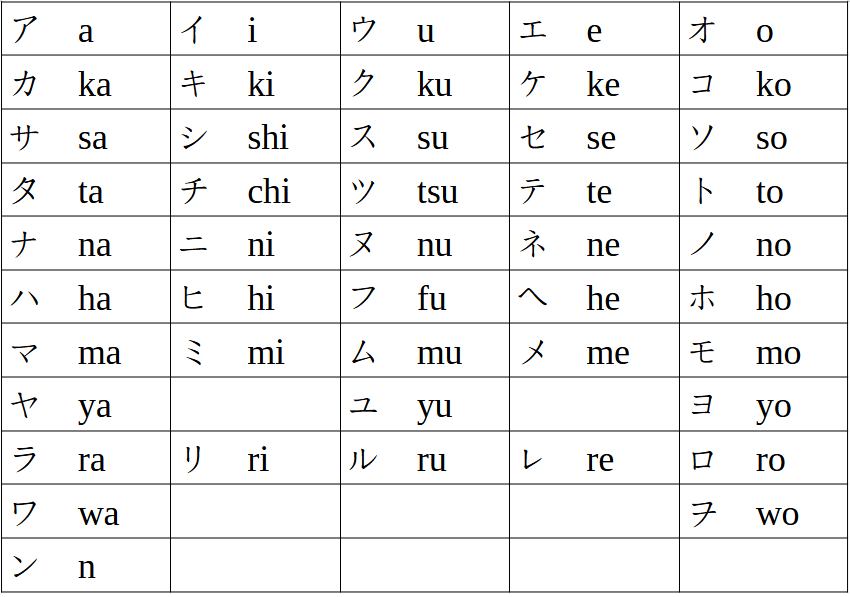
Some interesting things to note here with Katakana;
- The Hiragana へ and Katakana ヘ are the exact same character.
- There is a striking similarity between the Hiragana り and Katakana リ
- The characters シ (shi) and ツ (tsu) do look quite similar, but pay attention to the direction of the long stroke. And with time, you’ll easily be able to distinguish the two in text.
Everything else with Dakuten (゛), Handakuten (゜), and Youon (拗音) from Hiragana also apply here.
For example, the Katakana Ka (カ) can become Ga (ガ), Hi (ヒ) to Pi (ピ), and So (ソ) to Zo (ゾ), etc.
Also, Youon works the same, here are some examples:
キョ ギャ シャ ジョ ニャ ミョ
There’s not too much else to say on Katakana, as you read more and become exposed to the language, Hiragana and Katakana will become second nature. It will be a slow crawl at first to be able to immediately recognize a kana character for what it is, but it’s important to just keep trying, keep reading, keep trying to recognize characters and quiz yourself in the beginning.
I’m also a believer in writing as a way to help boost your memory. When you get the chance, or are just bored at times, find a pen and paper and write as many kana as you can remember. Quiz yourself with Kana memorization apps or flashcards or YouTube videos. Whatever method you can think of to remember your kana will help improve your reading speed and ability to recall how a kana is pronounced immensely.
 Learn Japanese With Me