Hiragana ひらがな
I consider learning Hiragana to be absolutely vital to the process of learning Japanese. Without learning hiragana, it’ll be almost impossible to effectively learn and read the language.
But doesn’t Japanese have another way to write it? Can’t you use the Roman letters (English Alphabet) to write out Japanese?
You can… but that’s probably one of the biggest pitfalls that I would recommend against entirely. It may in the short term make learning Japanese words easier to read, but it hurts your learning in the long term and you will struggle to effectively learn Japanese. Reading Japanese in the native way is the only way to effectively learn the language. So while Romaji (ローマ字) does exist, I would try staying away from it as much as possible.
A short personal anecdote I’ve noticed, whenever I see words in Romaji, I notice that since I’m not used to trying to read words in that way, I’m far slower to read and sound out the word in roman alphabetic characters than if the word were to be written in Hiragana or Katakana. So it may be slow and arduous at the beginning, but as you read more your reading speed will pick up guaranteed.
Anyway, with that out of the way, let’s actually study Hiragana now!
Hiragana Chart
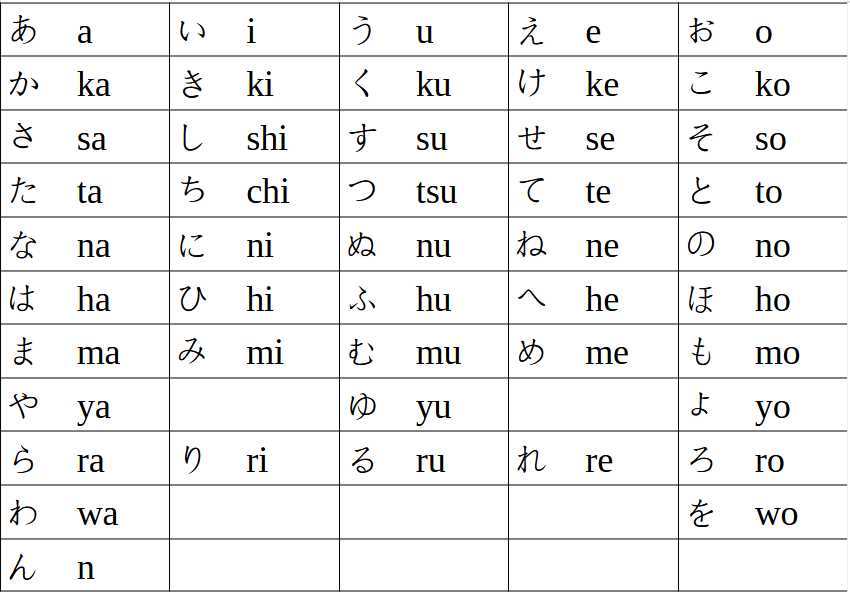
For each character above, the Japanese writing and the approximate English pronunciation is given. Notice the pattern in the chart where each column represents a specific vowel sound, and each row after the first row is the approximate consonant sound used to pair with the vowel.
There are also a set of sounds that can be made by adding a small symbol to the top of the kana, giving it a slightly different sound. These marks are called the Dakuten (゛) and Handakuten (゜). These are also known as the “voice mark” and “half voice mark”, since the idea behind these is that you add more “voice” to the consonant sounds of the kana. Where with the primary 48 kana, you would speak the consonant sound from the front of your mouth, you would speak the Dakuten kana from around the middle to back of the mouth.
But really, you can just think of these with the English consonant sounds that these represent.
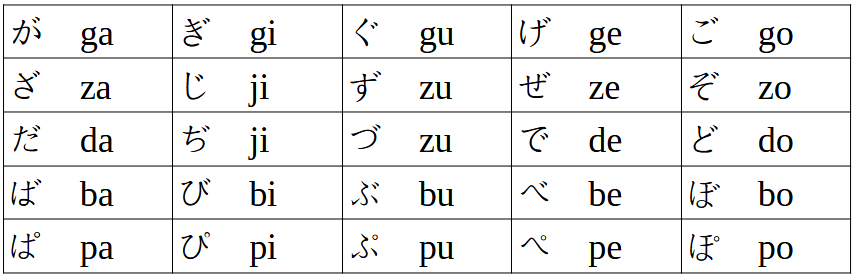
Notice that じ/ぢ and ず/づ have the same representative romaji sound, you can pronounce these the same.
Then, finally, we have the last of the sounds that makes up the Japanese phenoms, the Youon, or 拗音. These are sounds made by combining a -i ending kana sound with a smaller ya, yu, or yo sound to effectively combine them creating a XyX sound, like Kya, Gyo, or Nyu (きゃ、ぎょ、にゅ). These can be tricky to understand at first, but appear so often in the language that it takes no time at all to get used to them.
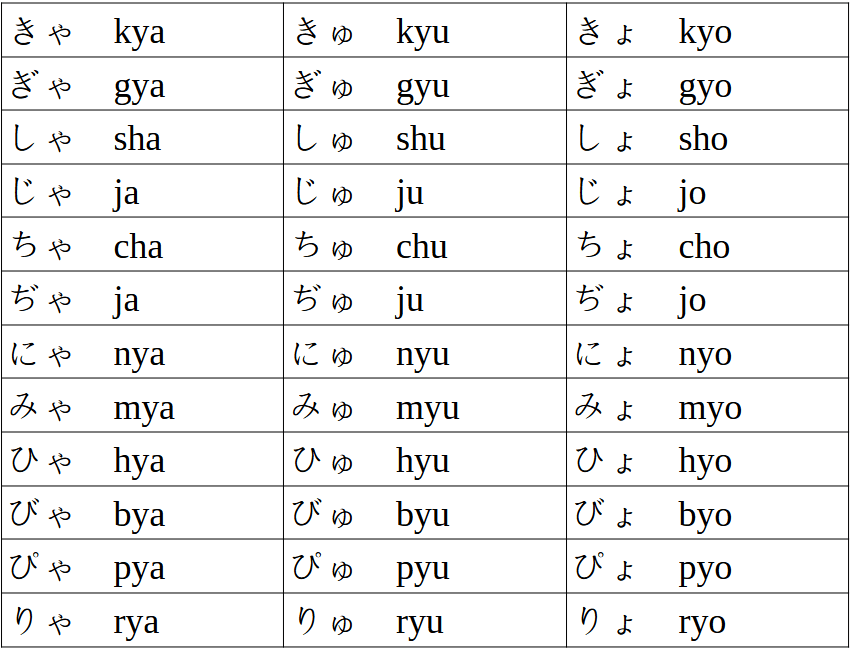
Overall, that’s 107 different sounds that you can make in Japanese. It may seem like a lot, but that’s it in terms of different sounds! (minus a few extra devoiced sounds, like して).
Pronunciation
This is a blog, so pronunciation is quite difficult to convey in text, you kinda just have to hear it to understand how they really sound like.
Thankfully, we have YouTube! There are plenty of videos out on YouTube to sound out hiragana natively.
https://www.youtube.com/results?search_query=hiragana+pronunciation
Or similar searches can be used to get a variety of videos for you to practice with!
Pay extra attention to ら、り、る、れ、ろ、りゃ、りゅ、りょ
These are not sounds that we use much in English, and can be quite difficult to get right. Essentially, it’s somewhere between an “r” sound, an “l” sound, and every sound except ら has a “d” heavy sound forward. Just listen to the way those are pronounced natively and get a feel for it by trying to replicate it as you go!
Okay, that’s it for Hiragana. There won’t be AS much to learn with Katakana because we won’t need to cover the dakuten and handakuten, youon, and pronunciation. Those concepts will apply over to Katakana as well.
 Learn Japanese With Me